The Challenge of Color Degradation in Food Additive Production
Processing heat-sensitive liquid colorants presents significant challenges for the food industry. Many food pigments are sensitive to thermal processing, and prolonged heat exposure during drying can contribute to pigment degradation and undesirable color changes. Such changes can affect the appearance and perceived quality of the final food additive. Therefore, selecting suitable drying conditions is important when processing color-sensitive ingredients.
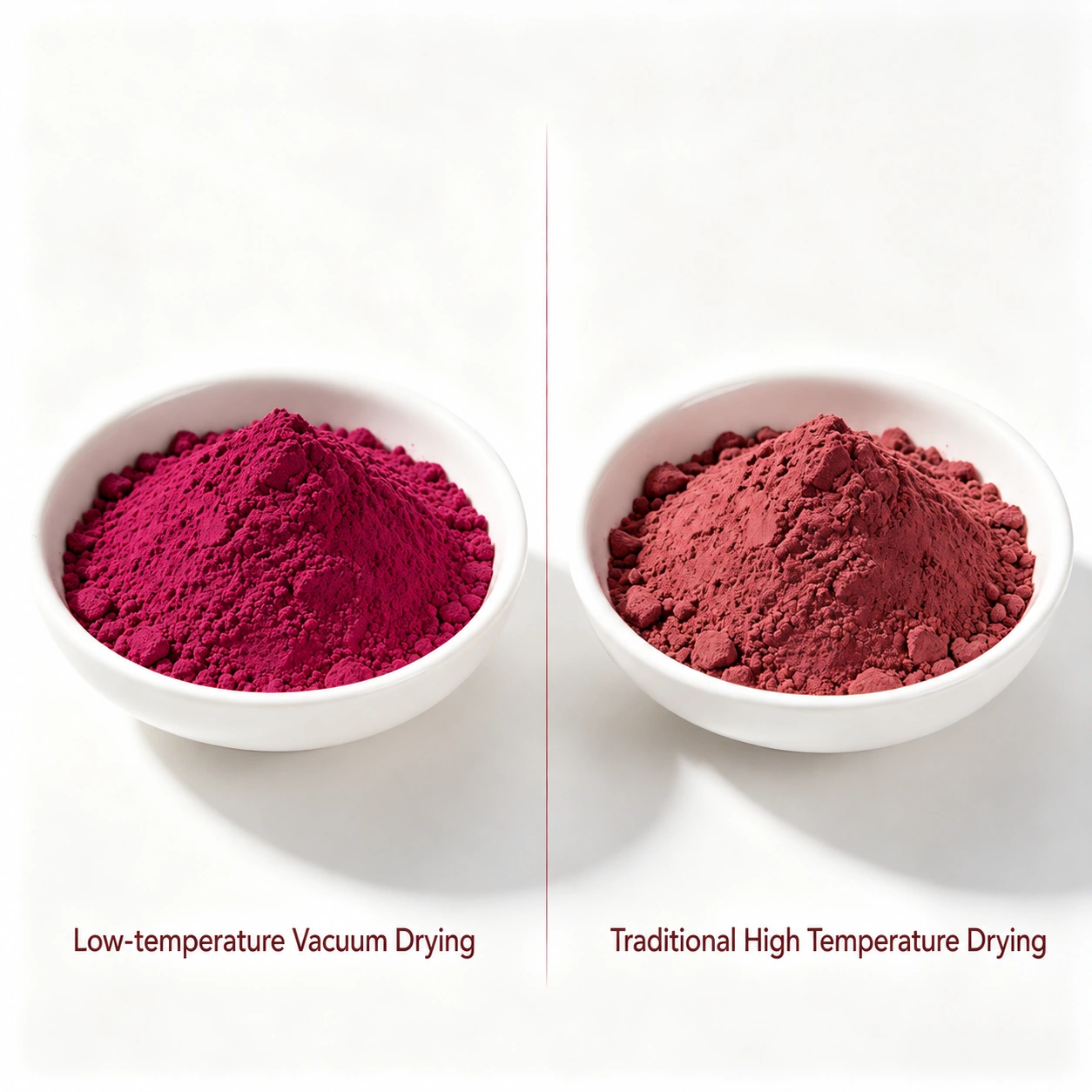
Published research also demonstrates that the choice of drying method can influence pigment retention and final product color. In a comparative study of red beetroot, Kerr and Varner reported that vacuum-dried samples showed strong color saturation and relatively high levels of betalain pigments. Under the conditions evaluated, continuous vacuum-belt drying produced beetroot powder with color and betalain characteristics comparable to freeze-dried products, while requiring a shorter drying time (Kerr & Varner, 2020).
Minjie Vacuum Belt Dryer: A Gentle Solution for Liquid Colorants
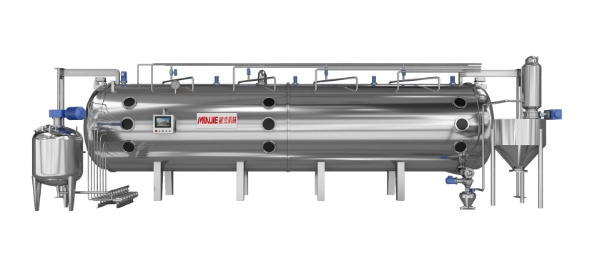
To address the high thermal exposure associated with spray drying and the long batch cycle of traditional vacuum ovens, Minjie Machinery developed the Vacuum Belt Dryer System for Liquid & Paste. The system continuously processes liquid and paste materials under vacuum.
Reduced pressure lowers the boiling point of the liquid phase, allowing moisture to evaporate at lower material temperatures. The drying temperature can be adjusted to suit the thermal sensitivity of the feed, helping reduce unnecessary thermal exposure during the drying of heat-sensitive liquid colorants.
Additionally, the equipment utilizes a temperature gradient design. When the liquid material first enters the dryer and the moisture content is high, a relatively higher temperature can be applied to improve evaporation efficiency. As the material moves along the belts and its moisture content decreases, the temperature in the middle and back sections is gradually reduced to lower the risk of over-drying or discoloration.
Practical Case: Drying Food Colorants
Food colorants can be sensitive to high temperatures and oxygen exposure during drying, which may lead to pigment degradation or color changes. In this food-colorant drying example, the Vacuum Belt Dryer System for Liquid & Paste was used to process the material through a continuous vacuum-drying sequence and produce a dried product.
The Continuous Drying Process for Liquid Colorants
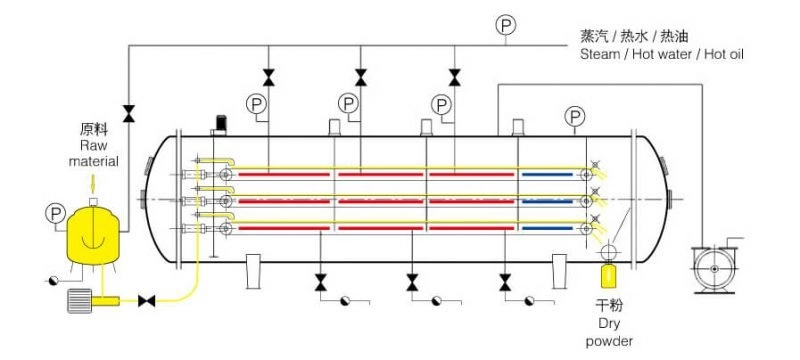
For liquid-colorant processing, an infeed pump delivered the material to a distribution device, which spread it across the moving belts. As the belts passed over the heating plates under vacuum, the material proceeded through evaporation, drying, and cooling. PLC-based control supports continuous operation while reducing manual transfer between processing steps. At the discharge end, the dried material was crushed into powder before continuous discharge or transfer to downstream processing.
Final Results: Uniform Color and High-End Quality
In this food-colorant application, the process achieved rapid drying with no obvious discoloration, and the finished material showed a consistent color. These qualitative results are relevant for food-additive processing where color appearance is an important product attribute.
Value for Food Additive Manufacturers
For food-additive manufacturers processing heat-sensitive liquid colorants, the Vacuum Belt Dryer System for Liquid & Paste combines vacuum drying, staged temperature control, and continuous material movement in one process. Continuous feed and discharge can reduce manual transfer steps and support a more consistent production flow. Adjustable process conditions also allow thermal exposure to be controlled throughout drying, which is particularly relevant when maintaining color appearance is an important product requirement.
Minjie has also established a dedicated test center to support material development and drying trials. Food-additive manufacturers are welcome to send or bring their liquid colorant samples for free pilot testing, allowing the drying behavior, moisture removal, appearance, and other target quality indicators to be evaluated before moving to production-scale processing.
Frequently Asked Questions
Q: Is a vacuum belt dryer suitable for highly viscous liquid food colorants?
A: It can be suitable for highly viscous liquid food colorants. The feed pump and distribution system spread the material onto moving belts.
Q: How does the vacuum belt dryer prevent color degradation in food additives?
A: The dryer creates a low-temperature vacuum environment that reduces heat exposure and contact with oxygen during drying. This helps prevent heat-induced pigment degradation and oxidation, reducing the risk of color change in food additives.
Q: Can this drying equipment help improve the uniformity of the final food colorant product?
A: Even distribution on the moving belts, controlled heating sections, and continuous belt residence help provide more consistent treatment across the material layer. This can reduce the uneven heating associated with static tray drying and support more uniform drying.
Q: Will the low-temperature drying process reduce the production efficiency for food colorants?
A: No. The Vacuum Belt Dryer operates continuously, allowing material to be fed, dried, and discharged without waiting for an entire batch to finish. Compared with intermittent batch drying, this continuous process improves production efficiency while maintaining low-temperature drying conditions.
Q: How can I confirm if my specific food additive sample is suitable for this drying method?
A: A pilot drying test can be used to assess how the sample feeds, dries, and discharges, as well as the resulting moisture level, appearance, and other target quality indicators.
Reference
Kerr, W. L., & Varner, A. (2020). Chemical and physical properties of vacuum-dried red beetroot (Beta vulgaris) powders compared to other drying methods. Drying Technology, 38(9), 1165–1174. https://doi.org/10.1080/07373937.2019.1619573