Overcoming Production Bottlenecks in High-Volume Manufacturing
The Hidden Costs of Batch Processing Downtime
In large-scale manufacturing, batch drying creates production slowdowns. Each cycle covers material charging, system heat-up, drying, cooling, and discharge. The next batch starts only after these steps finish. Material handling may receive partial automation. Yet repeated transition stages cut equipment availability. These stages also add thermal losses. Long residence times raise thermal exposure for heat-sensitive materials. High production volumes turn lost operating time, repeated thermal cycling, labor input, and batch-to-batch variability into higher unit production costs. The same factors weaken plant-level ROI.
Achieving Consistent Output Without Workflow Interruptions
A vacuum belt dryer uses continuous feeding and discharge to avoid batch-by-batch interruptions during steady production. For liquid and paste feedstocks, drying time can be reduced from 10–20 hours in traditional static drying to 30–60 minutes. Fewer start-stop transitions support more stable throughput, more predictable production scheduling, and better utilization of labor and utilities in high-volume operations.
Mechanisms of Efficiency: Heat Transfer and Workflow Automation
Optimizing How Systems Transfer Heat for Faster Evaporation
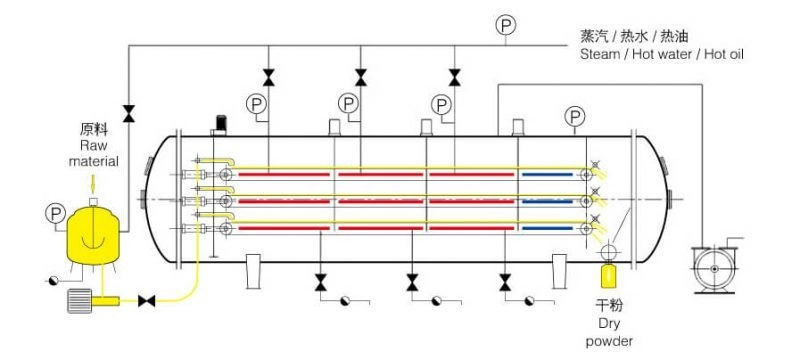
In a liquid/paste vacuum belt dryer, an infeed pump moves the product to a distribution device. The device spreads a controlled material layer across the moving belts. Vacuum lowers the boiling point of the liquid phase. Rapid evaporation occurs at a lower product temperature than atmospheric drying allows. Heat is supplied through heating plates using steam, hot water, or thermal oil, while belt movement maintains continuous contact between the product layer and the heated surface.
Vacuum Belt Dryer For Liquid & Paste workflow:
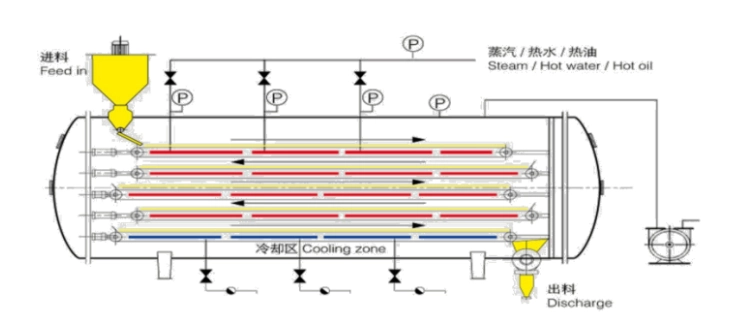
The powder/particle vacuum belt dryer uses a different structure, with 3–11 layers of conveyor belts installed inside the cylindrical shell. Wet solid material is continuously fed and distributed across the belts under vacuum. Belt movement continuously redistributes the material, increasing contact with the heated surfaces, accelerating moisture evaporation, and supporting more uniform drying.
Vacuum Belt Dryer for Powder & Particle workflow:
Reducing Labor Dependency Through Automated Feeding and Discharging
Automation reduces labor demand by replacing repeated batch charging and discharging with continuous, enclosed material handling. Liquid/paste vacuum belt dryers use an infeed pump and distribution device, while powder/particle models use a dedicated feeding and distributing unit. In both product categories, PLC control coordinates feeding, drying, and discharge, reducing routine manual handling. The closed process also limits dust release and reduces cross-contamination risk during production.
Enhancing Yield and ROI with Vacuum Belt Dryers
Preserving Product Quality with Low-Temperature Continuous Vacuum Environments
The two vacuum belt dryer designs use different operating ranges and provide different product-quality benefits. Liquid/paste models have an adjustable drying-temperature range of 30–300°C, while powder/particle models have a range of 20–300°C. Vacuum lowers the boiling point of the liquid phase, allowing many heat-sensitive products to dry at lower temperatures than in atmospheric systems. For liquid/paste applications, the documented benefits include better preservation of color, solubility, and valuable constituents. For powder/particle applications, controlled temperature and continuous material redistribution support more uniform drying and reduce the risk of thermal damage. Both designs can support the recovery of organic solvents such as ethanol, acetone, or methanol, reducing solvent loss and emissions.
Lowering Total Cost of Ownership (TCO) in Large-Scale Plants
Total cost of ownership falls when the dryer cuts recurring costs over its service life. Continuous feeding and discharge reduce labor demand and batch-transition time. Steady thermal operation avoids repeated heat-up and cool-down losses. Closed solvent recovery cuts solvent consumption and emissions. CIP cleaning shortens cleaning stoppages and limits manual cleaning. Product containment and controlled drying also reduce material loss, contamination risk, and off-spec output.
Applications Across High-Volume Processing Industries
Scaling Up Food and Beverage Extract Production
For food and beverage extracts, a liquid/paste vacuum belt dryer is most suitable for high-viscosity, thermoplastic, heat-sensitive, or easily agglomerating feedstocks. It is used to make malt extract, carbohydrate products, instant beverage powder, tea powder, cocoa powder, and corn paste, etc. The continued feeding and vacuum drying ensure high volume output for long periods without having to expose the material for long periods to heat.
Processing Chemical Powders and Agricultural Particles Efficiently
In chemical and agricultural processing, the powder/particle vacuum belt dryer is intended for solid, crystalline, granular, particle, and powder materials. It is especially suited to materials that are easily oxidized, flammable, explosive, highly irritating, or toxic. The enclosed system limits dust release and cross-contamination, while the product-contact design helps control magnetic and metallic foreign matter.
Minjie’s Engineering Capabilities for Long-Term Production Efficiency
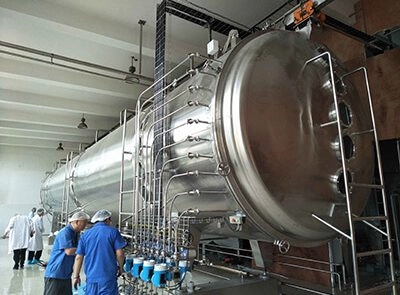
At Minjie Machinery, engineering stability and technological innovation support lower long-term operating costs by improving equipment reliability, maintainability, and process consistency. We operate a 58,000 m² manufacturing facility with more than 250 employees, including 15 senior engineers, and use CNC machining centers, automatic argon arc welding equipment, and automatic laser cutters to manufacture our systems. Our research and development portfolio includes five product series with proprietary intellectual property, supported by five invention patents and 56 utility model patents.
These manufacturing and engineering capabilities support durable equipment construction and repeatable system performance. CIP-compatible design helps shorten cleaning stoppages, while stable heat-transfer surfaces, vacuum control, and PLC automation support efficient operation. Minjie reports certification under ISO quality, environmental, and occupational health and safety management systems, together with ASME certification. Our low-temperature drying and concentration test platform supports process verification and engineering optimization before industrial deployment.
FAQ
Q: How does a vacuum belt dryer differ from standard continuous drying equipment?
A: Unlike standard continuous dryers, a vacuum belt dryer operates under reduced pressure, lowering the moisture boiling point and enabling continuous, low-temperature drying. This better preserves color, flavor, solubility, and heat-sensitive ingredients while reducing oxidation and drying time. It can process liquids, pastes, powders, or particles with adjustable temperature zones, automated feeding and discharge, and optional solvent recovery.
Q: What is the energy efficiency of continuous drying systems for large-scale operations?
A: Energy efficiency comes from steady-state operation rather than repeated batch heat-up and cool-down cycles. In a vacuum belt dryer, vacuum-assisted evaporation lowers the boiling point, while continuous heat transfer through the belt system reduces idle thermal losses. These mechanisms can lower energy use per unit of dried product in high-volume operations.
Q: Can continuous drying equipment handle both liquid pastes and powder particles?
A: Not with one identical machine configuration. The liquid/paste vacuum belt dryer uses an infeed pump and distribution device and has an adjustable drying-temperature range of 30–300°C. The powder/particle vacuum belt dryer uses 3–11 conveyor-belt layers and has a range of 20–300°C. Both provide continuous feeding and discharge, but their structures and material scopes are different.
Q: How do continuous drying systems reduce overall production downtime?
A: Continuous drying systems reduce downtime by avoiding repeated charging and discharging between every batch and by maintaining stable operation during long production runs. PLC-controlled feeding and discharge reduce routine manual intervention, while CIP cleaning shortens planned cleaning stoppages.
Q: What factors impact the ROI of upgrading to a high-capacity vacuum belt dryer?
A: ROI is driven by higher equipment utilization, lower labor input, reduced start-stop energy losses, lower product loss, and shorter cleaning downtime. For solvent-containing feedstocks, recovery of ethanol, acetone, or methanol can add further savings. In liquid/paste applications, lower-temperature vacuum drying can also preserve color and solubility, helping protect the value of the finished product.