Key Technical Criteria for Selecting Industrial Drying Equipment
Material Properties and Heat Sensitivity
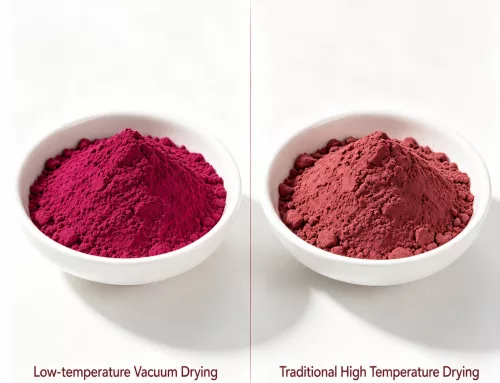
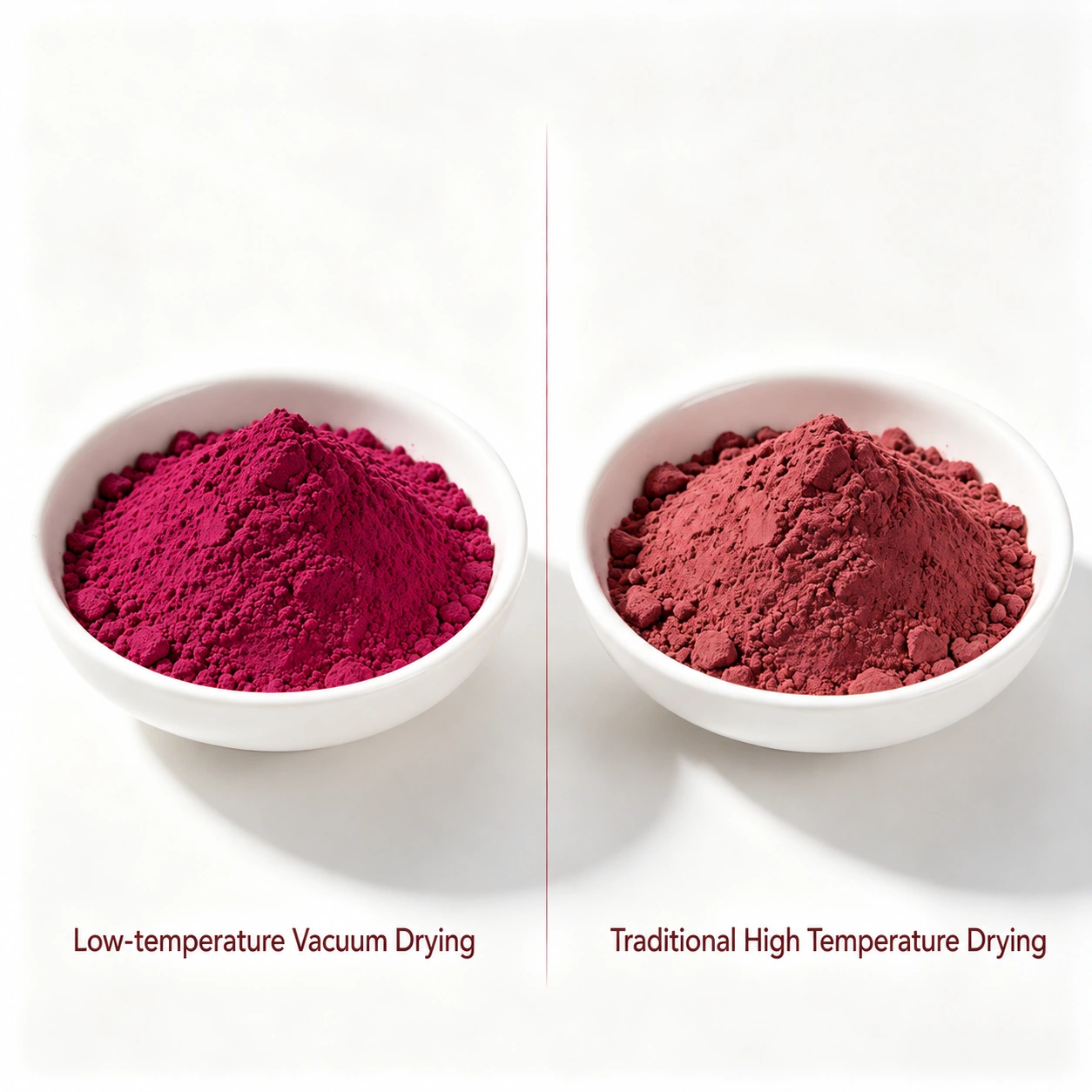
When evaluating industrial drying systems, the chemical and physical properties of the material remain the main engineering limits. Materials from the food, chemical, and new energy sectors often bring issues such as high viscosity, quick clumping, or thermoplastic behavior. Heat sensitivity stands as a vital point. Too much heat can cause denaturation or oxidation in these cases. For items that prove highly irritating, toxic, flammable, or explosive, engineers must apply a fully sealed system. This step avoids safety risks and outside pollution. Teams pick various drying and evaporation setups based on the material’s heat sensitivity, physical shape, solvent features, and final product needs. For heat-sensitive materials, methods that use lower temperatures or added vacuum often work best. These approaches cut thermal stress while moisture leaves the product.
Moisture Content: Initial vs. Target Levels
Knowledge of the feed moisture, solid content, solvent type, viscosity, and needed final moisture or concentration helps with proper equipment sizing. For liquid and paste materials, input moisture often sits between 20 and 80 percent. Such feeds demand strong evaporation power to reach an adjustable product moisture of 0.2 to 5 percent. For solid powder or particle materials, the feeding moisture usually falls from 10 to 80 percent. The target final moisture lies between 0.3 and 5 percent. The chosen equipment must maintain steady evaporation rates. These rates connect closely to the drying temperature and the kind of heating media, such as steam, hot water, or hot oil.
Production Throughput and Batch vs. Continuous Processing
The decision between batch and continuous systems affects facility output and labor needs in direct ways. Traditional batch processing often needs long drying periods that run from 10 to 20 hours before the target moisture appears. A shift to continuous processing systems can shorten this drying time to 30 to 60 minutes for liquid and paste materials. The same change brings drying times of 20 to 120 minutes for solid powders. Continuous vacuum systems support automatic feeding, drying, solvent recovery, cooling, granulation, and discharge under vacuum in many cases. These features lower manual work and help keep production throughput stable.
Matching Your Process with the Right Type of Dryer
Vacuum Belt Dryer
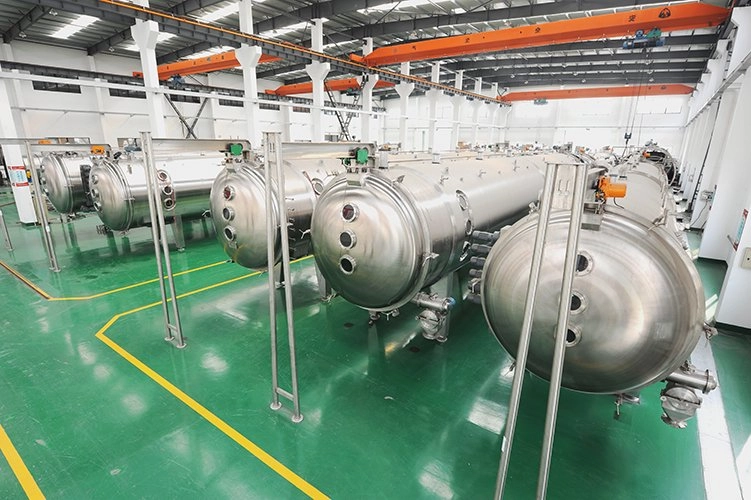
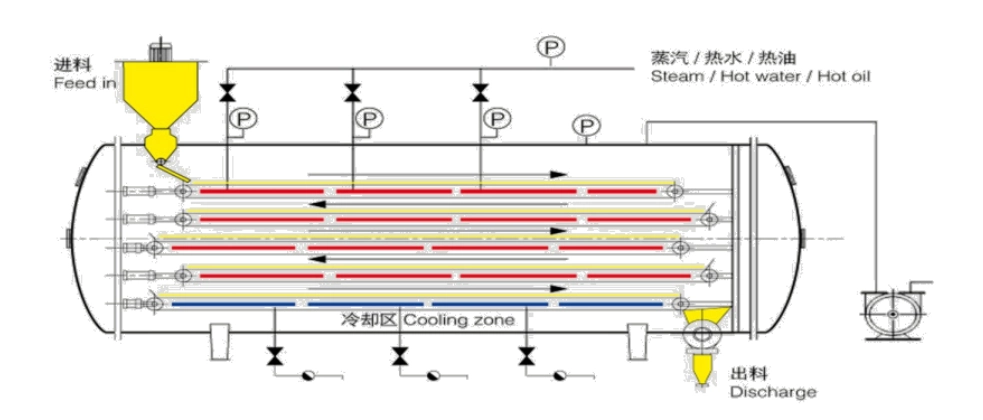
A vacuum belt dryer works well when materials need low-temperature drying, continuous runs, less manual work, and a sealed processing space. For liquid and paste processing, the material moves into the dryer body through an infeed pump. The system spreads the material evenly on belts. High vacuum lowers the boiling point of the liquid, so evaporation happens at adjustable temperatures from 30 to 300 °C. For powder and particle drying processing, the cylindrical shell holds 3 to 11 layers of conveyor belts that run between 20 and 300 °C. The system also controls magnetic foreign matter and metal impurities. This control matters a great deal in chemical, new energy, and high-cleanliness material processing.
Vacuum Drying Oven
Traditional vacuum drying ovens handle materials in separate batches. Workers load the wet material onto trays by hand. They place the trays inside the chamber and apply heat under vacuum to pull out moisture. This approach fits small-scale operations that deal with thermal sensitive materials. Still, the method brings longer processing cycles and greater labor demands because of the manual loading and unloading steps. Long contact with heat inside a traditional drying oven can create denaturation issues. As a result, vacuum drying ovens suit small-batch production, laboratory-scale trials, or materials that accept longer residence times under steady vacuum conditions.
Freeze Dryer
Freeze drying uses the idea of sublimation. The material first gets frozen. Then a vacuum is applied and, while keeping the pressure constant, the temperature is increased so the frozen water changes straight from solid to gas. This process keeps the cellular structure and active ingredients safe. Yet the method usually needs large energy for refrigeration and vacuum support. Batch processing times also run long. Freeze dryers fit best when the final product must keep a porous structure, active ingredients, or strong rehydration performance.
Spray Dryer
Traditional spray drying employs high-temperature air to atomize liquid feeds into dry powder in a quick manner. This step can damage sensitive parts through heat. To address the high temperature issue linked with traditional methods, Minjie created a continuous vacuum spray dryer that removes heated air. The mixture travels through a special heating device. The solvent or moisture inside the liquid feed turns to vapor during transport at a low vaporizing temperature of 50–80°C. At the same time, the solid content separates and collects inside the vacuum separation chamber. This kind of system receives evaluation for liquid feeds that hold proper solid content. The evaluation focuses on cases where lower-temperature vaporization, solid-liquid separation, and solvent or moisture recovery stand as key requirements.
Fluidized Bed
Fluidized bed systems work by sending an upward stream of gas through a bed of solid particles. The gas suspends the particles and creates maximum surface area for heat exchange. This technology delivers high efficiency for sturdy, free-flowing granular materials. However, high viscosity, quick clumping, or uneven particle sizes can stop proper fluidization. These problems lead to wet areas and uneven drying.
Footprint, Energy Efficiency, and Operational Costs
Evaluating Energy Consumption in Drying Systems
Energy consumption varies significantly across drying technologies based on thermodynamics and processing cycles. Traditional vacuum drying ovens require extended batch cycles of 10 to 20 hours, resulting in prolonged utility use. Switching over to continuous vacuum belt dryers cuts total heat use through shorter processing periods of 30 to 60 minutes. Freeze dryers need the most energy per kilogram of water removed because the units require lots of electricity for refrigeration compressors and vacuum pumps during sublimation. Fluidized bed dryers provide fast water removal from granular solids with large amounts of heated gas. Continuous airflow in such systems leads to high heat energy use unless exhaust heat gets recovered. A traditional spray dryer uses 450 kilograms of steam and 210 kilowatts of power to remove 150 kilograms of water each hour. Continuous vacuum spray dryers reduce steam to 180 kilograms and power to 45 kilowatts at the same output rate.
Facility Space Constraints and Equipment Layout
Equipment layout must match the existing facility space and utility connections. Large traditional systems often need extensive ductwork, cyclone separators, and air handling units. These parts take up vertical and horizontal space. Modern equipment such as the continuous vacuum spray dryer uses a skid-mounted layout. The compact setup needs only a small footprint and makes installation simpler. Modular systems can arrive pre-assembled and pre-commissioned. This preparation shortens on-site installation and commissioning once connections link to the user’s utilities and auxiliary equipment.
Testing and Validation Before Final Procurement
The Importance of Pilot Testing for Industrial Drying Machines
The evaporation capability of any system depends on material properties, the heating medium, operating temperature, initial moisture content, and the type of solvent. Theoretical calculations need confirmation through actual trials. A pilot test with sample materials helps determine the real evaporation amount and product behavior under vacuum conditions. When buyers select a drying system, they should ask if the manufacturer offers pilot testing, sample evaluation, evaporation data, and process recommendations before final purchase. A dedicated test platform proves useful because the platform confirms whether the suggested equipment meets the required moisture, throughput, and product-quality targets.
Partnering with a Reliable Drying Equipment Manufacturer
The engineering capability of the manufacturer serves as a critical selection criterion. Minjie was founded in 1998. Our factory covers an area of 58,000 square meters. We employ over 250 staff, including 15 senior engineers. To keep product quality stable, we apply advanced manufacturing equipment such as automatic argon arc welders, automatic laser welders, and CNC machine centers. Minjie Machinery has passed ISO quality management, environmental management, occupational health and safety management systems, and ASME certification. We hold long-term cooperation with well-known enterprises like the Nestle Group and Dupont Group. The machines have reached over 20 countries around the world.
FAQ
Q: How do I choose the best industrial drying equipment for heat-sensitive food products?
A: Heat-sensitive products need moisture removal at controlled, low temperatures. This step prevents thermal degradation and protects color and solubility. Equipment that works under high vacuum lowers the boiling point of liquids. Evaporation then occurs at adjustable temperatures from 30 to 300°C, based on the specific system. The final product form guides the choice among suitable options that include vacuum belt dryers, freeze dryers, or other low-temperature drying systems. The decision rests on whether the product needs concentration, powder formation, porous structure retention, or continuous production.
Q: What is the main difference between a vacuum drying oven and a freeze dryer?
A: A vacuum drying oven removes moisture by heating materials under reduced pressure. A freeze dryer first freezes the material, then removes ice by sublimation under vacuum. The main difference is temperature and drying mechanism: vacuum ovens use heat-driven evaporation, while freeze dryers use low-temperature sublimation, better preserving heat-sensitive samples.
Q: Which industrial drying system is most energy-efficient for continuous bulk processing?
A: Energy efficiency in bulk processing comes from reduced heat loss and improved solvent recovery. Closed continuous systems such as continuous vacuum spray dryers or vacuum belt dryers use less steam and power. These systems avoid the need to heat large volumes of ambient air.
Q: When should a manufacturer upgrade from a batch dryer to a continuous vacuum belt dryer?
A: A manufacturer should upgrade when handling high-value raw materials requiring low loss, when large-scale continuous production is needed, or when batch drying causes uneven drying and batch-to-batch variation. It is also suitable if high temperatures increase HMF, Maillard reactions, color changes, or flavor loss.